
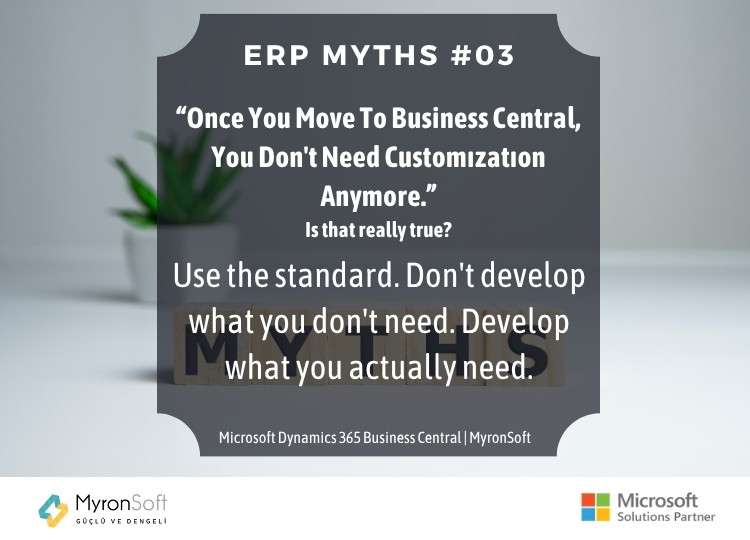
ERP Myths #03
“Once You Move to Business Central, You Don’t Need Customization Anymore.”
This is one of the most common assumptions about Business Central.
“Business Central is a standard ERP. Microsoft keeps improving it. So there is no longer any need for custom development.”
If only ERP projects were that simple.
The real principle is not:
“Never customize.”
It is:
“Never customize unnecessarily.”
Because the purpose of an ERP system is not simply to run standard processes.
Its purpose is to connect the way a business operates with the right technology.
Why does standard functionality matter?
One of Business Central’s strongest advantages is its mature standard functionality.
Finance, purchasing, sales, inventory, warehousing, manufacturing, projects, service and reporting are supported by capabilities that have evolved over many years.
Therefore, the first question in a Business Central project should not be:
“How do we develop this?”
It should be:
“Can Business Central already do this?”
If standard functionality meets the requirement, rebuilding it through custom development often creates unnecessary cost and technical debt.
But there is an important distinction.
Strong standard functionality does not mean every business operates in the same way.
Every company operates differently
Two companies may operate in the same industry.
They may even sell the same products.
Yet their business processes can be completely different.
One company may use a specific approval process for orders, while another may have a completely different pricing structure.
A manufacturer may have unique production planning requirements.
A distributor may operate through a complex dealer network.
A services company may have its own contract, billing or revenue model.
This is where Business Central’s flexibility becomes important.
But flexibility does not mean:
“Let’s write custom code for everything.”
Good ERP consulting also means knowing when to say no
When a customer says:
“We’ve been doing it this way for years.”
the consultant’s job is not simply to reproduce the process in Business Central.
The first question should be:
“Why do you do it this way?”
Sometimes the existing process is genuinely critical to the business.
Sometimes it is a customization created years ago for a problem that no longer exists.
This is one of the most valuable aspects of an ERP transformation.
Instead of moving everything from the old system to the new one, the business should reassess what it actually needs.
A good ERP consultant is therefore not only someone who can develop software.
They are also someone who can:
prevent unnecessary development.
When is custom development actually needed?
Custom development can make sense when standard Business Central functionality cannot adequately address the requirement.
For example:
- the business has a critical proprietary business rule,
- industry-specific requirements cannot be handled through standard functionality,
- a unique calculation or pricing model is required,
- a specialized integration is necessary,
- the business has a process that creates competitive advantage,
- regulatory or operational requirements demand it,
- a significant user-experience improvement is needed.
But even then, the architecture of the development matters.
Should every NAV customization be moved to Business Central?
In most cases, no.
One of the most common mistakes in NAV-to-Business Central projects is attempting to migrate every customization from the old environment.
A customization created years ago may no longer be necessary.
Business Central may now provide the same functionality as standard.
A development that was once essential may have become obsolete in the new platform.
Therefore, every existing customization should be questioned:
Why was it created?
Is it still being used?
Is it still business-critical?
Can Business Central handle it as standard?
Can the requirement be solved in a simpler way?
This is where a real transformation begins.
AppSource can also be part of the answer
Building everything from scratch is not the right strategy either.
The Business Central ecosystem includes applications designed for different industries and business requirements.
A practical decision framework can therefore have three levels:
- Business Central standard functionality
If the requirement can be handled through standard capabilities, start there.
- AppSource / existing applications
If a mature and reliable solution already exists, evaluate it before developing from scratch.
- Custom development
If the business has a genuinely unique or critical requirement, custom development may be the right choice.
This approach can help control both implementation cost and long-term maintenance.
“No customization” is not a strategy
There is another misconception worth addressing.
The success of a Business Central implementation should not be measured by:
“We didn’t build anything custom.”
Likewise, saying:
“We developed everything the business requested.”
is not a success metric either.
Success means:
Choosing the right solution for the right requirement.
Sometimes that is standard functionality.
Sometimes an AppSource application.
Sometimes an integration.
Sometimes a small extension.
Sometimes a fully custom development.
The important metric is not the amount of code written.
It is the business value created.
The MyronSoft approach
At MyronSoft, we evaluate the business requirement before the development.
Because in an ERP project, it is easy to say:
“Yes, we can develop that.”
The difficult question is:
“Do you actually need it?”
Using Business Central’s standard capabilities wherever possible, reducing unnecessary technical debt, and developing only where there is a genuine requirement creates a much more sustainable ERP environment.
Our approach is simple:
Use the standard.
Don’t develop what you don’t need.
When development is necessary, develop it correctly.
Because the quality of an ERP system should not be measured by how much code has been written.
It should be measured by how much better the business operates.
Conclusion
“Once you move to Business Central, you won’t need any customization.”
That’s an ERP myth.
The reality is:
Business Central can significantly reduce unnecessary customization. It does not eliminate the genuine requirements that make your business different.
A well-designed Business Central implementation does not aim to be:
100% standard.
It aims to be:
100% fit for purpose.
Sometimes that means writing no code at all.
Sometimes it means writing exactly the right code.
The real expertise lies in knowing the difference.